Chip antennas are a type of antenna integrated on a PCB, where a specific component (‘chip’) is part of the radiating structure. This can involve implementing impedance matching for a structure on the PCB, providing the radiating element, or serving as a part of it.
Although it might be assumed that an antenna can simply be bought as a component, soldered onto a PCB, however, this is not the case. Unlike most other electronic components, antennas always interact with their environment, as they facilitate wireless communication.
The surrounding environment significantly affects the functionality of the antenna. Even with a thorough understanding of antenna principles and following the data sheet, there’s a substantial risk that, at best, the antenna may not work as expected, and at worst, its performance could be severely degraded.
Chip Antenna With CHW3021
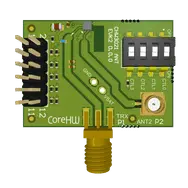
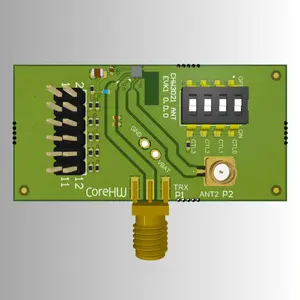
CoreHW has developed an RF front-end component CHW3021 that includes chip-antenna functionality in addition to being a PA/LNA component with antenna diversity in the ISM2.4GHz band. CHW3021 does not need any external components for any of its functionalities, and everything is included in the 2mm-by-2mm chip-scale package.
CHW3021 Chip Antenna needs a clearance next to the IC that is only 3% of the area of the PCB, leaving the rest for other components, battery, connectors, and so on. Regular PCB trace antennas usually require significantly larger area for the same efficiency. The chip antenna in a simple 50mm-by-25mm PCB offers -1dB efficiency with 15dB return loss with linearly polarized radiation pattern.
Chip Antenna Design Service
CoreHW offers comprehensive design services for chip-antenna applications, considering various factors such as PCB size and layout, enclosure, product environment, and regulatory restrictions. We provide design services for all types of antennas, whether traditional trace antennas or chip antennas.