
16 Phase-Balanced RF Antenna Ports
Connects one RF transceiver path to as many as 16 single-ended, 50 Ω antenna ports.
Use a fast, low-loss, phase-balanced RF switch with low switching transients in your Bluetooth® AoA/AoD antenna-array design.
Up to 16
Phase-balanced antenna ports
Bluetooth® AoA/AoD
Antenna switching
Indoor + outdoor
Applications
Low power
Designed for efficient devices
Fast switching
Responsive antenna control
Product Introduction
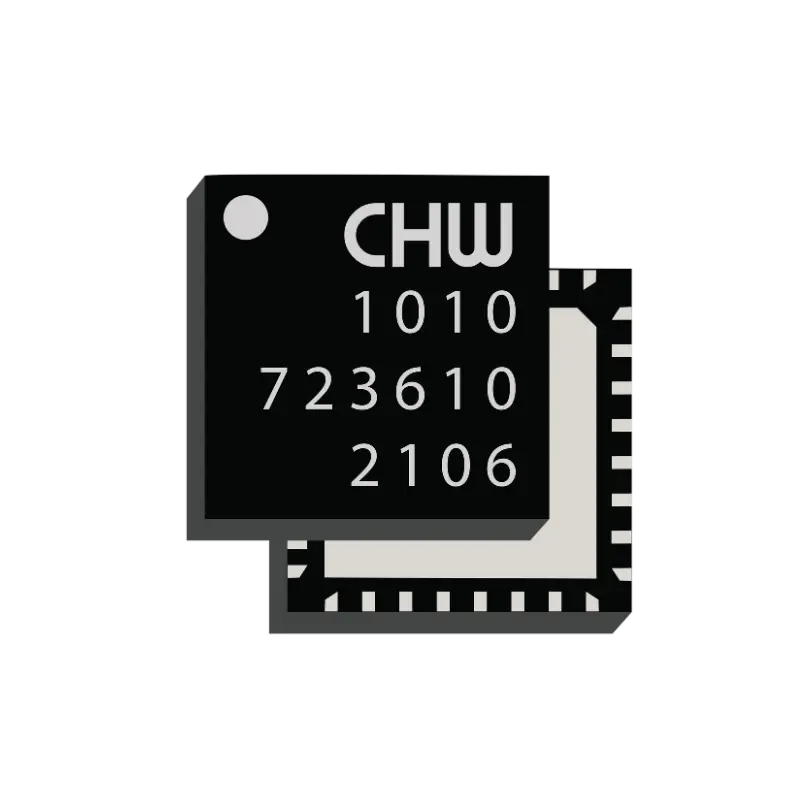
CHW1010 is a phase-balanced SP16T RF antenna switch IC for Bluetooth® AoA/AoD systems. It connects one RF transceiver path to as many as 16 antenna ports, enabling accurate AoA/AoD antenna arrays for RTLS, indoor positioning, asset tracking, and locator infrastructure.
Product Family
CHW1010 is the RF antenna switching core inside Bluetooth® AoA/AoD locators, anchors, gateways, and antenna array systems. It is optimized for embedded RTLS infrastructure where phase balance, switching speed, low emissions, and low power matter.
The product belongs to CoreHW’s SP16T RF switch and Bluetooth® AoA/AoD product family. It supports custom antenna arrays, CoreHW reference antenna boards, single-locator or multi-locator RTLS architectures, and low-power embedded designs.
RF Switch Capabilities
Connects one RF transceiver path to as many as 16 single-ended, 50 Ω antenna ports.
Designed specifically for Bluetooth® AoA and AoD antenna switching.
Reduces unwanted spectral emissions during AoD operation.
Supports accurate angle estimation across antenna-array channels.
Unused and inactive antenna ports are internally terminated to 50 Ω.
Simple 6-pin GPIO interface for antenna selection, AoD-TX mode, and chip enable.
Suitable for compact and battery-powered embedded systems.
Available in a QFN32 package measuring 4.0 × 4.0 mm.
Multiple CHW1010 devices can be combined to support larger antenna-array configurations.
Starts in approximately 15 µs, supporting responsive embedded operation.
Applications

Staff tracking, patient flow, medical asset tracking, access-zone monitoring.
Business Outcomes

Tool tracking, work-in-progress tracking, automated process triggers, vehicle tracking.
Business Outcomes

Pallet tracking, forklift tracking, inventory visibility, item finding.
Business Outcomes

Indoor navigation, occupancy analytics, access control, space utilization.
Business Outcomes

Worker location, equipment tracking, zone monitoring.
Business Outcomes

Customer movement analytics, proximity services, shopping guidance.
Business Outcomes
Why CoreHW
SYSTEM ARCHITECTURE
CHW1010 connects one Bluetooth® transceiver RF path to up to 16 antenna ports using GPIO-controlled switching. It is designed for Bluetooth® AoA and AoD positioning antenna arrays.
In AoA operation, the receiver samples antennas sequentially to estimate angle of arrival. In AoD operation, CHW1010 switches between antennas while transmitting the Constant Tone Extension.
The device supports Normal operation and AoDTX soft switching, with internal 50 Ω termination on unused antenna ports.
Technical Data
| RF switch type | SP16T |
|---|---|
| Frequency range | 2.402–2.480 GHz |
| Antenna ports | 16 single-ended 50 Ω ports |
| Transceiver interface | Single-ended 50 Ω |
| Insertion loss | 2.7 dB typical |
| Control interface | GPIO-controlled antenna selection |
|---|---|
| Firmware compatibility | Compatible with Bluetooth® AoA/AoD firmware stacks |
| Supported Bluetooth® SoCs | Nordic Semiconductor, Silicon Labs, Texas Instruments, NXP, Dialog/Renesas, and other Bluetooth® LE chipsets |
| Hardware integration | Minimal external components required |
| Antenna interface | Direct connection to antenna arrays |
Technology Choice
Resources
Technical overview of the CHW1010 SP16T RF antenna switch IC.
Product
Evaluate high-accuracy Bluetooth® AoA RTLS in your own facility before scaling.
Product
Bluetooth® AoA locator for real-time 3D asset and personnel tracking.
Product
Integrated electronics platform for building custom Bluetooth® AoA RTLS tags.
Quick Answers
CHW1010 is a 16-port SP16T RF antenna switch IC optimized for Bluetooth® AoA and AoD.
The device is optimized for Bluetooth® AoA/AoD systems.
SP16T means Single Pole, 16 Throw. One RF transceiver path can be connected to one of 16 antenna ports.
It operates across 2.402–2.480 GHz, covering the Bluetooth® LE 2.4 GHz band.
Low phase mismatch helps reduce angle-estimation error in antenna arrays, improving positioning performance.
AoDTX mode is CoreHW’s soft antenna-switching mode for reducing unwanted spectral emissions during AoD switching.
Yes. Multiple devices can be used to build larger antenna-array configurations.
Yes. It operates from 1.7–3.6 V, has low current consumption, and starts up quickly.
Yes. It is designed for RTLS locators, Bluetooth® AoA/AoD positioning gateways, indoor positioning, navigation, and asset-tracking infrastructure.