Design chip and PCB antennas around the real product—PCB layout, enclosure, RF front end and operating environment.

Application-Specific Antenna Performance
Chip antennas are a type of antenna integrated on a PCB, where a specific component—the chip—is part of the radiating structure. This can involve implementing impedance matching for a structure on the PCB, providing the radiating element, or serving as part of it.
Although it may seem that an antenna can simply be purchased as a component and soldered onto a PCB, this is not the case. Unlike most electronic components, antennas continuously interact with their surroundings because they radiate.
The surrounding environment significantly affects antenna performance. Even with a thorough understanding of antenna principles and careful use of the datasheet, there is a substantial risk that the antenna will not perform as expected—or that its performance will be severely degraded.
Integrated 2.4 GHz RF Front End
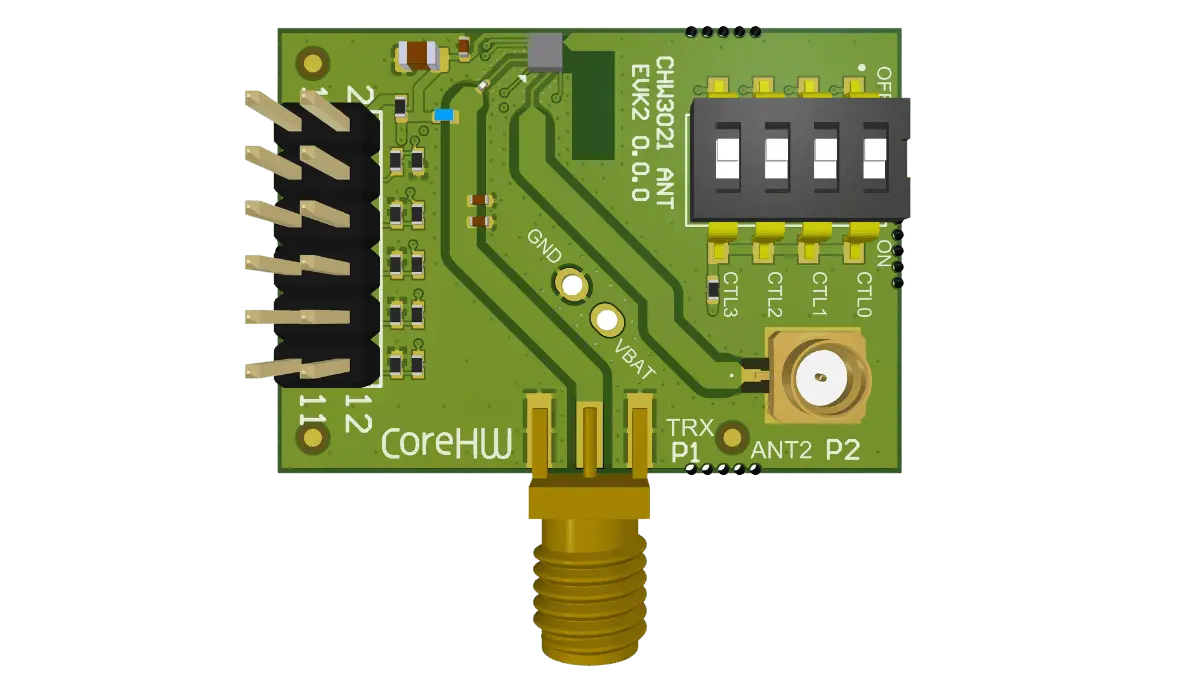
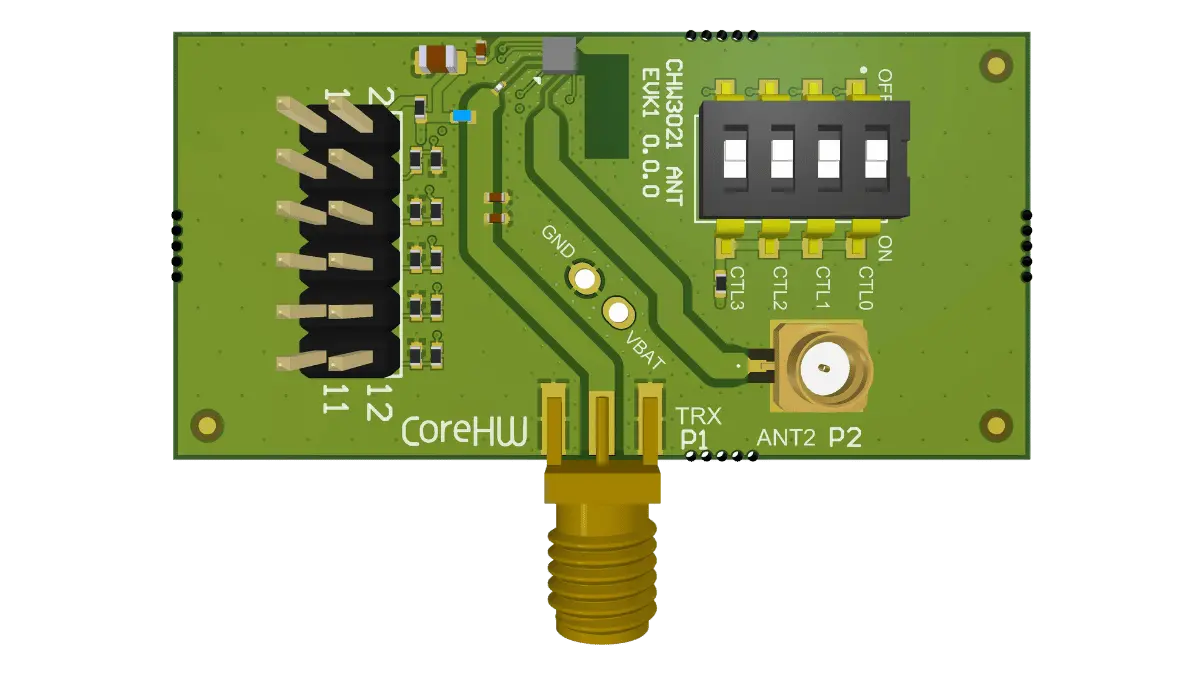
CoreHW has developed the CHW3021 RF front-end IC, which combines chip-antenna functionality with a PA, LNA and antenna diversity for the 2.4 GHz ISM band.
The RF matching is implemented on-chip, minimizing the need for any external RF components for its functionalities. The functionality is integrated into a compact 2.0 mm × 2.0 mm chip-scale package.
The CHW3021 chip antenna requires only a small clearance area next to the IC, leaving more PCB area available for other components, the battery, connectors and other product functions. Regular PCB trace antennas typically require significantly more area for comparable efficiency.
In a simple 50 mm × 25 mm PCB, the chip antenna achieves:
−1 dB
antenna efficiency
15 dB
return loss
Linearly polarized
radiation pattern


Custom Antenna Engineering
CoreHW offers comprehensive custom chip antenna design services based on the requirements of the complete product, not only the antenna component.
The antenna design can account for:
CoreHW can support the antenna approach that best fits the product architecture and performance requirements, whether traditional trace antennas or chip antennas.
Frequently Asked Questions
A chip antenna does not operate independently from the product around it. PCB dimensions, ground structure, nearby components, enclosure materials and the surrounding environment can all affect impedance, efficiency and radiation performance. Datasheet layouts are useful references, but the final antenna must be optimized for the actual product.
An initial assessment typically starts with the target frequency band, PCB dimensions and layout constraints, enclosure information, available antenna area, product environment and relevant regulatory requirements. These factors help determine the most suitable antenna implementation.
Yes. CoreHW provides antenna design services for both chip antennas and traditional PCB trace antennas. The antenna type can be selected based on available space, RF performance, product architecture and other application requirements.
CHW3021 is particularly relevant for compact 2.4 GHz Bluetooth®, Zigbee, Thread and other ISM-band products where RF integration and PCB area are important. It combines the PA, LNA, chip antenna and antenna diversity in a 2.0 mm × 2.0 mm chip-scale package.
Start Your Antenna Design
CoreHW can evaluate the PCB, enclosure, antenna architecture and RF integration together to define the right antenna approach.