
Staff Location
Locate nurses, clinicians, technicians, operators, and support personnel faster when coordination or response matters.
Know where people are indoors when it matters. CoreRTLS delivers real-time Bluetooth® AoA tracking for staff, patients, workers, visitors, and contractors.
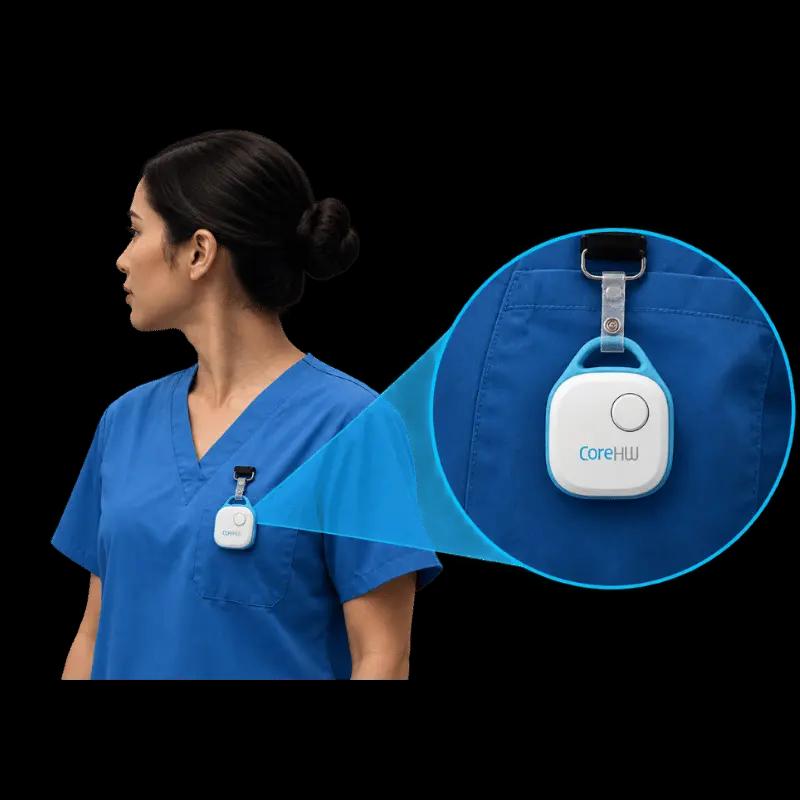
Staff & Patient Visibility
Locate people in real time.
Worker Safety
Support duress, lone-worker, and mustering.
Movement Analytics
Analyze routes, dwell time, and occupancy.
API Integration
Connect through MQTT and REST API.
OVERVIEW
RTLS people tracking provides continuous indoor visibility of staff, patients, workers, visitors, and contractors using wearable location Tags and indoor positioning infrastructure.
It supports staff safety, patient flow, lone-worker protection, emergency mustering, movement analytics, and workflow automation at the room, zone, sub-meter, or 3D coordinate level selected for the deployment.
OPERATIONAL VISIBILITY
Locate nurses, clinicians, technicians, operators, and support personnel faster when coordination or response matters.
See whether tagged patients are in the expected room, corridor, care area, or department.
Support location-aware staff assistance, lone-worker visibility, and configurable duress workflows.
Use live location and zone information to support evacuation checks and mustering dashboards.
Track temporary personnel in controlled areas while applying appropriate privacy and access rules.
Analyze routes, dwell time, occupancy, patient flow, utilization, bottlenecks, and response patterns.
WHY COREHW
HOW IT WORKS
CoreHW CoreRTLS combines wrist-worn or lanyard tags, locators, positioning software and APIs to provide real-time indoor location data for people and staff. Applications can use this data for live location, movement history, safety alerts, mustering and workflow coordination.
APPLICATIONS

Locate nurses, clinicians, porters, technicians, and support staff to improve response, coordination, and workflow visibility.

Track patients across rooms, corridors, waiting areas, treatment areas, and care units. Support workflows where it matters to know whether a patient is in the expected location.

Help care teams locate patients who may move into the wrong corridor, room, ward, or restricted area within the facility.

The programmable tag button can support location-aware assistance or duress workflows when configured in firmware, software, and the customer application.
Support visibility for workers operating alone in warehouses, laboratories, plants, maintenance areas, and restricted zones.

Use real-time location and zone data to support mustering RTLS, evacuation checks, and emergency-response dashboards.

Track temporary personnel, contractors, or guests in controlled areas while enforcing privacy, purpose limitation, and access rules.

Analyze routes, dwell time, zone occupancy, bottlenecks, patient flow, staff utilization, and response patterns.
POSITIONING PERFORMANCE
CoreRTLS can deliver 3D positioning down to ±10 cm in suitable environments. Actual performance depends on locator placement, tag orientation, line of sight, room layout, ceiling height, multipath, people density, update rate, and system configuration.
Do we need exact coordinates, room-level visibility, or zone-level awareness?
For staff RTLS and patient tracking, the best deployment is not always the highest-density deployment. A hospital room, corridor, production cell, or mustering zone may require different accuracy. Start with the business question and design the deployment around the answer.
Evaluation Considerations
TECHNOLOGY COMPARISON
PRIVACY AND GOVERNANCE
People tracking should be deployed for a defined operational, safety, or care purpose with appropriate access controls and governance. Before rollout, define who can access location data, how long it is retained, which workflows require precise location, and how employees, patients, visitors, or contractors are informed where applicable.
The final solution should also address cybersecurity, role-based access, data retention, system ownership, and any applicable workplace, healthcare, or privacy requirements. CoreRTLS provides the positioning foundation; the customer and solution provider define the application-specific policies and workflows around the location data.
Governance Considerations
EVALUATION KIT
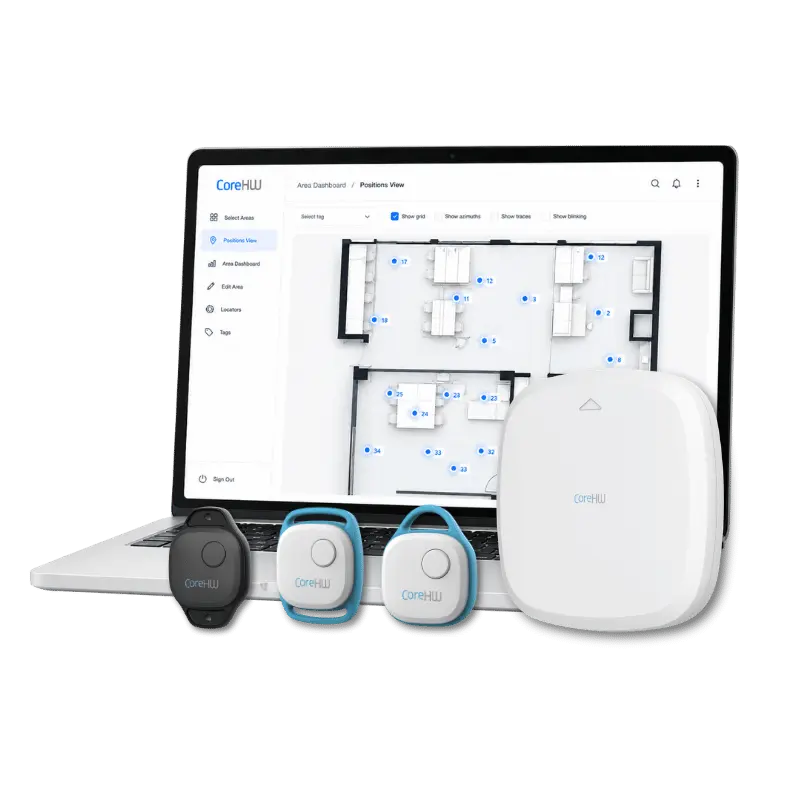
CoreRTLS-EVK4 helps you prove RTLS people tracking in your own environment before production deployment. Use it to test accuracy, coverage, latency, locator placement, WebUI visualization, MQTT data collection, REST API integration, and real workflow conditions.
ARCHITECTURE
CoreRTLS integrates wearable tags, indoor positioning infrastructure, software, and APIs into a complete people-tracking platform that solution providers and system integrators can build on.
CoreRTLS Wrist Tags, Lanyard Tags, and CoreRTLS Locators provide the wearable and positioning hardware.
CoreRTLS Software calculates real-time positions and provides system management, WebUI, and device lifecycle tools.
MQTT streams real-time location data, while the REST API connects CoreRTLS with customer systems and applications.
Solution providers and system integrators build safety workflows, patient applications, mustering dashboards, alerts, analytics, reports, and customer-facing interfaces.
Connect CoreRTLS with healthcare systems, safety applications, facility platforms, dashboards, workforce tools, and custom automation.
FAQ
RTLS staff tracking is real-time indoor location tracking for staff using wearable tags and locator infrastructure.
Yes. CoreRTLS supports wearable wrist and lanyard tags for personnel and patient tracking.
CoreRTLS supports 3D positioning down to ±10 cm in suitable environments. Many staff and patient use cases may require only room-, corridor-, zone-, or sub-meter accuracy.
Yes. CoreRTLS tags include a programmable button that can support location-aware assistance or duress workflows when configured in the customer application.
Yes. Real-time location and zone data can support emergency mustering and evacuation dashboards through integration.
People tracking should be deployed with role-based access, a clear purpose, retention rules, appropriate employee or patient communication, and secure system architecture. Privacy and security requirements depend on the deployment, jurisdiction, and customer application.
Wearable CoreRTLS Tags, CoreRTLS Locators, CoreRTLS Software, network connectivity, and an application or integration layer.
Use CoreRTLS-EVK4 to evaluate positioning performance, workflows, privacy requirements, and API integration in your facility.
Yes. CoreRTLS wearable tags include a programmable button, accelerometer, and temperature sensor. The button can support location-aware events such as staff duress, patient assistance, check-in, workflow confirmation, or emergency alerts, depending on the customer application and configuration. Temperature and motion data can also support application-specific monitoring or automation workflows.
START YOUR RTLS PILOT
Evaluate CoreRTLS with your real rooms, corridors, workflows, wearable tags, and integrations before moving to production deployment.