
Lost Equipment
Find critical tools, devices, containers, and shared assets before downtime starts.
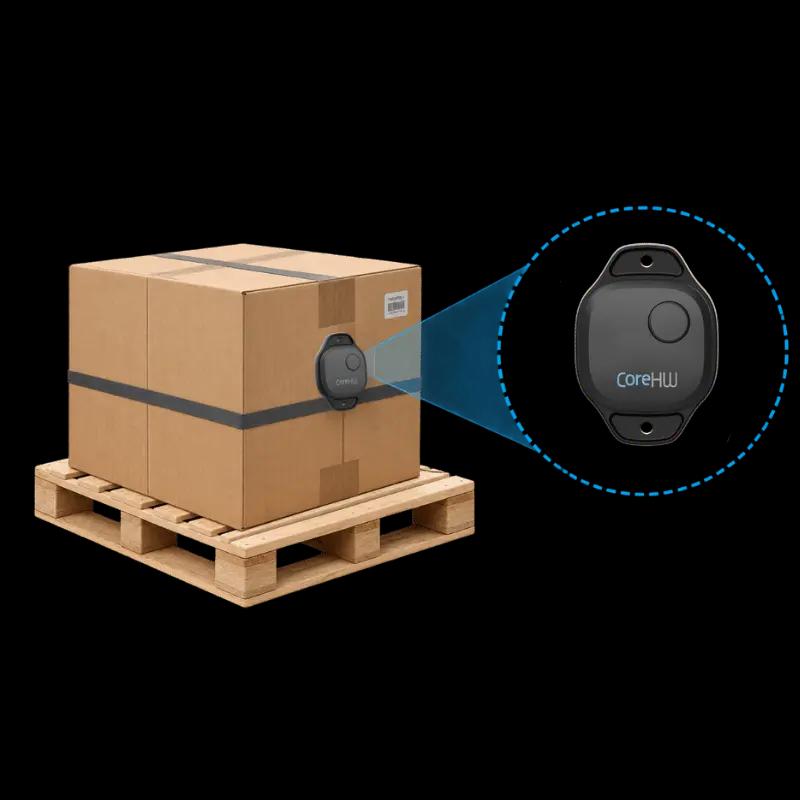
Track equipment, containers, pallets, tools, medical devices, inventory, forklifts, vehicles, and people indoors in real time with CoreRTLS Bluetooth® AoA tags, locators, positioning software, and enterprise APIs.
Real-Time Visibility
See tagged assets live.
High Precision
Down to ±10 cm 3D positioning.
Continuous Tracking
Follow assets as they move through your facility.
Easy Integration
Connect through MQTT and REST API.
Overview
RTLS asset tracking provides continuous, real-time indoor visibility of tagged assets, tools, equipment, inventory, vehicles, and people. Unlike barcodes, QR codes, or passive RFID, which depend on manual scans or fixed read points, CoreHW CoreRTLS uses Bluetooth® AoA positioning to show where an asset is now, where it has moved, and how long it has remained in a location or zone.
CoreRTLS is designed for operations that need more than basic identification, including live location, movement history, alerts, workflow automation, and precise 3D indoor positioning down to ±10 cm in suitable deployments. The platform supports warehouses, manufacturing, healthcare, laboratories, logistics, retail, hospitality, and other indoor environments through RTLS tags, locators, positioning software, MQTT, and REST APIs.
Problems
Find critical tools, devices, containers, and shared assets before downtime starts.
Locate wheelchairs, infusion pumps, beds, analyzers, carts, and other high-value devices faster.
See routes, dwell time, idle time, and process flow as assets move through production or logistics.
Trigger alerts in customer applications when an asset moves, stops, leaves a zone, or stays too long.
Locate tagged service assets, carts, table-service devices, and other valuable operational equipment across large venues and facilities.
See which tools, equipment, and shared assets are in use, idle, or unavailable to improve utilization and reduce unnecessary purchases.
Why CoreHW
How It Works
CoreHW CoreRTLS combines tags, locators, positioning software and APIs to provide real-time indoor location data for tagged assets. Attach a CoreRTLS Tag to each asset to make its location visible in real time. Asset-tracking applications can display current location, movement history and location-based alerts—helping teams find equipment faster and improve asset utilization.
Applications

Track pallets, cages, containers, forklifts, staging areas, loading zones, and high-value inventory with real-time RTLS visibility.

Track jigs, fixtures, parts, tools, carts, AGVs, production vehicles, and WIP between cells, lines, and buffers.

Locate medical assets, lab devices, staff, patients, carts, beds, pumps, and shared equipment across departments.

Monitor forklifts, vehicles, material-handling equipment, trailers, and movement between receiving, storage, and dispatch.

Track handheld devices, carts, cleaning equipment, service assets, tagged tables, and valuable operational assets.
Technology Comparison
Pilot
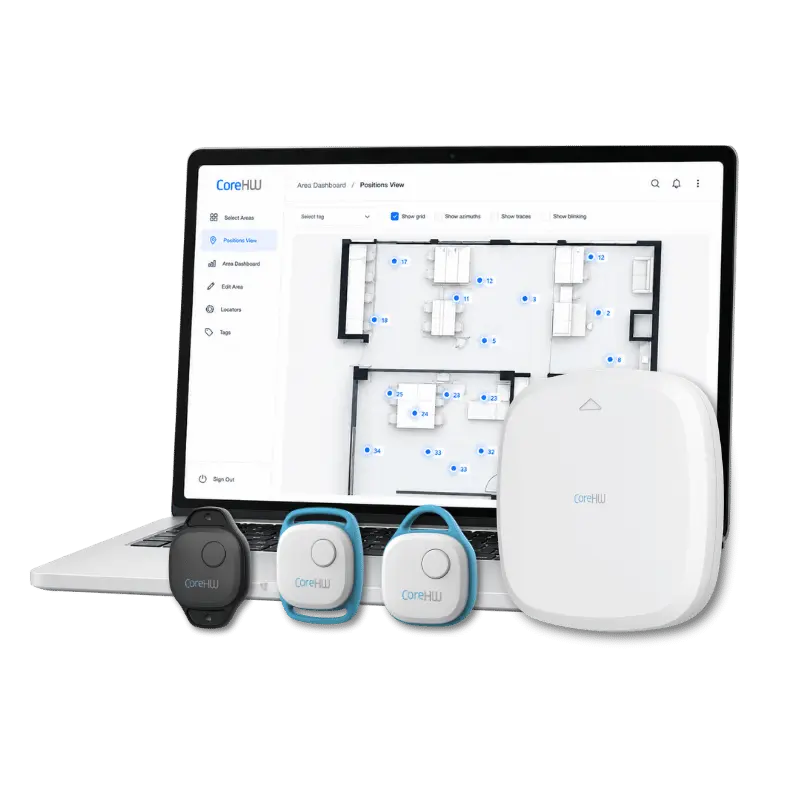
CoreRTLS-EVK4 helps you prove the system in your own environment before full deployment. The evaluation kit includes four CoreRTLS Locators, two CoreRTLS Tags, CoreRTLS Software on a Linux MiniPC, a PoE switch with cabling, WebUI live positioning, MQTT data streaming, and REST API integration for proof-of-concept testing.
Integration
CoreRTLS connects tags and locators to positioning software, open APIs, and customer applications across one integration architecture.
CoreRTLS Asset Tags and Locators.
CoreRTLS Software handles real-time positioning, system management, WebUI, and device lifecycle tools.
MQTT streams real-time location data, while the REST API connects CoreRTLS with customer systems and applications.
System integrators turn location data into alerts, workflows, geofencing, reports, analytics, and customer-facing applications.
Connect CoreRTLS with WMS, ERP, MES, CMMS, dashboards, healthcare systems, venue applications, and custom automation.
FAQ
The best system depends on the required accuracy, environment, asset type, update rate, and integrations. For applications that require high-precision real-time 3D positioning, CoreHW CoreRTLS uses Bluetooth® AoA asset tracking.
CoreHW CoreRTLS supports indoor 3D positioning down to ±10 cm in suitable deployments. Accuracy should always be verified in the actual facility.
Yes, when antenna design, locator placement, calibration, RF environment, tag placement, and positioning algorithms support it. CoreHW designs the stack from antenna technology to positioning software to enable high-precision indoor tracking.
RFID typically identifies items at scan points or portals. RTLS continuously tracks location, movement, routes, dwell time, and real-time status.
For high-precision real-time positioning, Bluetooth® AoA is generally the better fit. Bluetooth® RSSI is typically used for zone-level or proximity-based presence, while Bluetooth® AoA uses angle-based measurements for more precise positioning.
Both Bluetooth® AoA and UWB can support high-precision indoor tracking. UWB uses a dedicated radio ecosystem with specialized anchors and tags, while Bluetooth® AoA benefits from the broader Bluetooth ecosystem with typically cheaper and more power efficient AoA tags. The best fit depends on accuracy requirements, infrastructure, tag power, device availability, cost, and integration needs.
Yes. CoreRTLS can track tagged pallets, inventory, forklifts, tools, containers, and staging assets in real time.
Yes. CoreRTLS supports asset tags and personnel tags on the same platform.
A CoreRTLS deployment typically includes CoreRTLS Tags, CoreRTLS Locators, CoreRTLS Software, network connectivity, and an integration layer or customer application.
Yes. CoreRTLS provides MQTT and REST API interfaces for integration with enterprise and customer applications.
Use CoreRTLS-EVK4 to evaluate accuracy, latency, update rate, locator placement, coverage, and integrations in your own facility.
Locator placement, geometry, installation height, RF multipath, line of sight, tag placement and density, update rate, calibration, and the physical environment all affect positioning performance.
It depends on the area size, ceiling height, obstructions, required accuracy, and use case. A pilot helps define the appropriate locator count and placement for the facility.
Get Started
Use CoreRTLS-EVK4 to evaluate positioning accuracy, coverage, latency, and integration in your real operating environment before moving to a production deployment.