Real-time Staff & Patient Location for a Large Health System

Project Overview

Sector: 

Integrator: 

Scope: 

Primary use: 

Solution: 

Healthcare (hospital deployments)

Leading healthcare system integrator

Multi-hospital projects across three hospitals

Real-time tracking of staff and patients, regulatory compliance and staff-workflow optimization

CoreHW Bluetooth AoA RTLS including CoreRTLS locators and Tag devices, CoreRTLS software, integration with the customer platform via MQTT and REST API.

Increased Efficiency

Executive Summary

A healthcare system integrator deployed CoreHW’s Bluetooth AoA RTLS to enable reliable staff and patient tracking across hospital environments. Following evaluation and phased pilots, the solution was integrated into the hospitals’ platform to support regulatory compliance, and staff workflow visibility—demonstrating scalable, room-level positioning suitable for multi-hospital deployments.
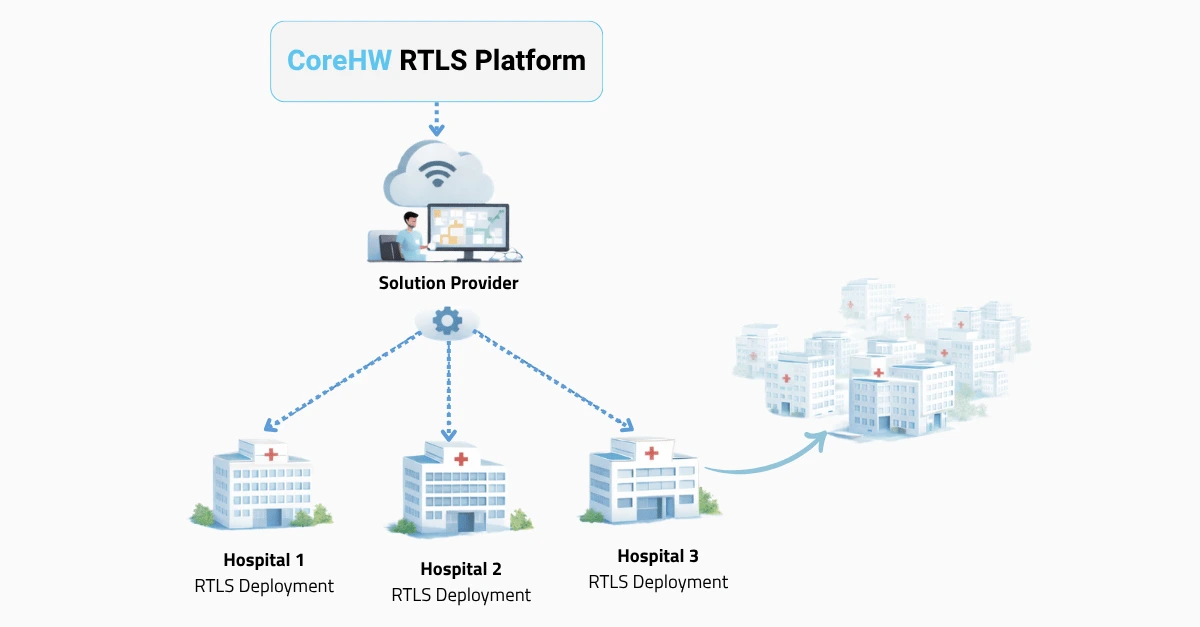
RTLS deployment

Background and Challenge

Hospitals must know who is where — reliably and in real time — to support clinical workflows, patient safety, and increasingly strict regulatory requirements. The customer’s existing RSSI-based beacon system could not deliver the consistent room-level accuracy and reliability required for compliance-critical use cases, while also falling short on long-term operational efficiency such as battery life and total cost of ownership.
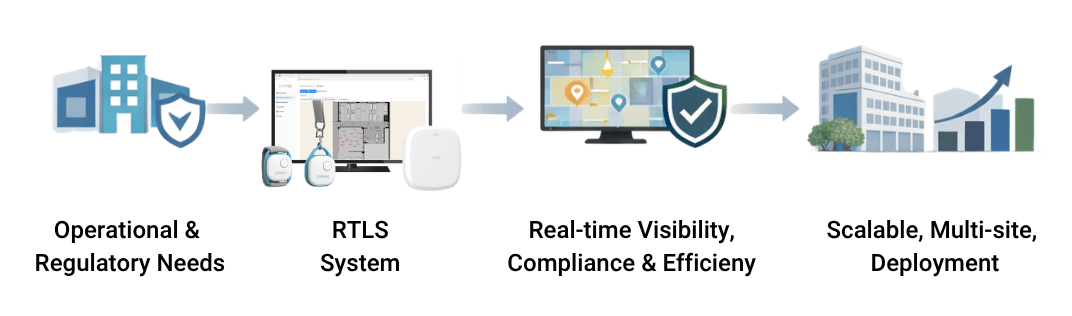
RTLS project milestones

Key challenges

  • Need for sub-meter/room-level reliability for hygiene, safety and workflow assurance.
  • Existing approaches (Wi-Fi/RSSI) were insufficiently accurate; UWB raised battery-life concerns for wearable tags.
  • Desire to minimize installation cost and disruption to hospital operations.
  • Regulatory and safety risk: failing to meet future compliance could carry severe financial/legal consequences.

Why CoreHW was selected

The customer chose CoreHW’s Bluetooth Angle-of-Arrival approach for a mix of technical and commercial reasons:
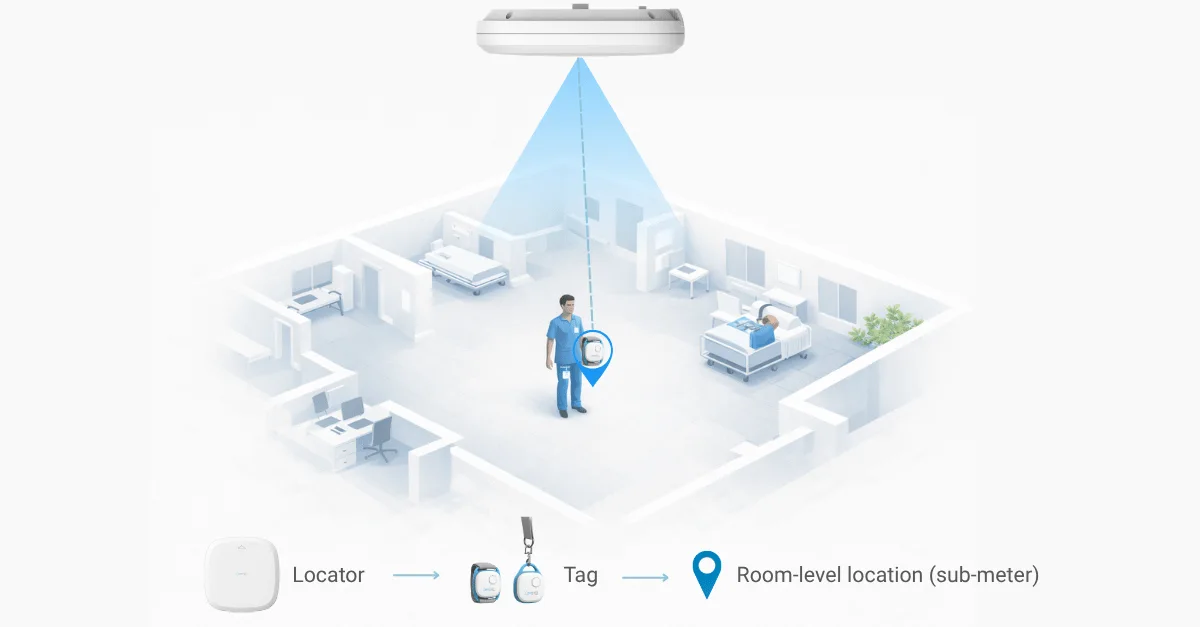
  • Room-level accuracy / sub-meter positioning delivered by AoA (meets the hospital’s practical requirement).
  • Multi-year battery life on tags under typical hospital use.
  • Lower TCO compared to alternatives (UWB’s tag power profile and Wi-Fi’s lack of accuracy).
  • Infrastructure-light deployment — ceiling/wall-mounted locators, fast proof-of-value via an evaluation kit and staged POCs.
  • Turnkey support during field testing and POCs. CoreHW provided active engineering support throughout integration, which materially reduced friction.
  • Turnkey offering: full hardware, software, integration with their platform
  • Interoperability — system adapted to work with existing customer devices during the pilot.
  • Integration flexibility: CoreHW’s software integrated with the integrator’s platform via APIs and was deployable in the cloud, matching the integrator’s enterprise architecture preferences.

What we delivered

The deployment followed a structured progression from validation to production. The integrator first evaluated the technology using an evaluation kit to validate Bluetooth AoA performance in real hospital environments. This was followed by a focused proof-of-concept phase, where the CoreHW RTLS position engine, locators, and tags were integrated with the integrator’s platform and aligned with operational workflows.

After successful validation, the project moved to hospital pilots, allowing optimization of locator placement, system configuration and application integration in live clinical environments.

The RTLS engine was deployed in the integrator’s cloud infrastructure, enabling scalable multi-site management and integration with their enterprise platform. This phase also helped identify network latency characteristics typical of cloud environments and refine the system architecture.

Performance & operations

Following deployment and system stabilization, the solution demonstrated reliable operational performance in real hospital environments, meeting the customer’s practical requirements for positioning accuracy, responsiveness, and long-term scalability.

  • Positioning: customer needed room-level accuracy, but achieved sub-meter performance suitable for the customer’s workflows. The customer confirmed practical accuracy exceeded their expectations during live demonstrations.
  • Latency: Cloud deployment exposed variable internet latency which as such does not hinder the system performance in the practical use, but motivates moving critical processing to local edge servers in hospitals, model which is fully supported by CoreHW.
  • Reliability & uptime: The system has run operationally in production hospitals without major outages for an extended period.
  • Battery life: Estimated multi-year battery life in normal hospital usage profiles (field estimate up to~3 years in typical use).
  • Scalability: Architecture and deployment model support scaling to additional hospitals and tens of sites; the customer has expressed high-level interest in broad roll-out.

Business impact

The RTLS solution delivered measurable operational value and critical risk mitigation:

  • Regulatory readiness & risk reduction: The integrator explicitly cited avoiding regulatory non-compliance and expensive legal exposure as a primary driver — CoreHW’s solution gave them the traceability they needed for audit and safety workflows.
  • Operational confidence: Staff movement is visible at room (sub-meter) level, enabling faster response, better workflow verification (e.g., room visits) and improved patient-safety workflows.
  • Path to scale: Customer intends to expand beyond the pilot sites, indicating commercial confidence in the approach.
  • Strong support relationship: Hands-on and iterative software improvements were decisive in converting a trial into a multi-site RTLS system.

CoreHW’s Bluetooth AoA RTLS enables healthcare providers to achieve reliable, sub-meter staff visibility, meet regulatory demands, and scale confidently—delivering a future-ready foundation for real-time, data-driven hospital operations.